There is a moment most people have experienced: listening to a voicemail that sounds robotic, stilted, or obviously automated, and deleting it before it finishes. That experience has conditioned a lot of prospects to tune out anything that does not sound genuinely human. For businesses using ringless voicemail, this is the single biggest obstacle to strong callback rates, and for a long time it was a real limitation of the technology.
AI voice cloning has changed that completely. What was once a novelty reserved for film studios and research labs is now a standard feature inside platforms like RinglessVoicemail.AI, and it is reshaping what businesses can realistically achieve with outbound voicemail drops. This article explains what voice cloning actually is, how it works inside a ringless voicemail platform, why it drives higher engagement than any previous approach, and how to use it properly across your campaigns.
What AI Voice Cloning Actually Means for Voicemail
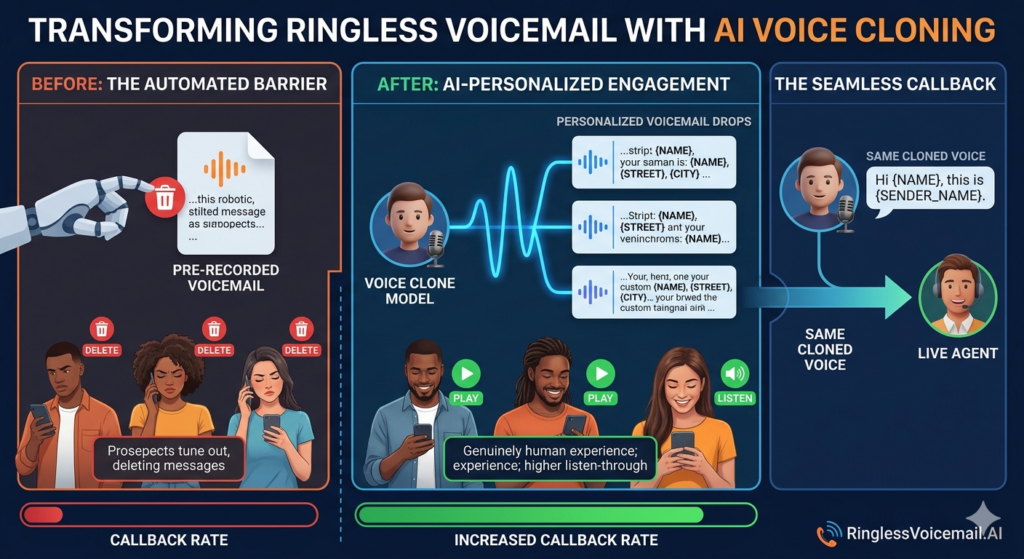
Voice cloning in the context of ringless voicemail is not the same as recording one message and playing it back repeatedly. That is traditional pre-recorded voicemail, and its weakness is obvious: every recipient hears the exact same audio, which means personalisation is limited to whatever you said in a single generic script.
AI voice cloning takes a short audio sample of a real person and builds a model from it. That model can then synthesise new audio in that voice from any text input. The result is that every single voicemail in a campaign can contain completely different content, with the same voice delivering it naturally, including names, addresses, locations, loan amounts, vehicle details, or any other variable pulled from your contact list.
So instead of a prospect hearing a generic pitch, they hear their name, their street, their city, delivered in a voice that sounds like a real person called them specifically. That shift is not cosmetic. It is the difference between a message that feels like a broadcast and one that feels like a real call.
How the Technology Works Inside RinglessVoicemail.AI
The platform combines two components that work together: the AI-generated personalised voicemail system and the AI Interactive Voice Response engine that handles callbacks.
On the outbound side, you provide a voice sample, typically a few minutes of clean audio. The platform builds a voice model from it. You then write a script template using variable placeholders pulled from your CSV columns: things like first name, city, address, vehicle model, loan amount, or any custom data field you carry. When the campaign runs, the system generates a unique audio file for every row in your data, with the synthesised voice delivering that specific contact’s information naturally.
On the inbound side, the same technology powers the personalised IVR that answers callbacks. When a prospect calls back, they hear a greeting that uses their name and references the original message, reinforcing the sense that they are dealing with a real person who knows who they are. That continuity between the outbound drop and the inbound callback experience is what turns a voicemail campaign into something that feels like genuine relationship-driven outreach rather than a mass marketing blast.
Why Natural-Sounding Voice Increases Callback Rates
The psychology here is straightforward. People respond to voices the way they respond to faces: they make trust judgements almost instantly, and anything that registers as artificial trips the same mental alarm that makes people suspicious of unknown callers.
When a voicemail sounds like a real person left it specifically for you, a few things happen. The listen-through rate goes up because there is no obvious automated tell to trigger the skip reflex. The message registers as a personal communication rather than a marketing blast, which lowers resistance to the callback. And the personalised content creates relevance signals that activate the part of the brain that processes socially meaningful information rather than advertising.
These are not small differences at the margin. Campaigns using AI-personalised voice drops consistently outperform generic pre-recorded drops across all the industries the platform serves, including real estate,solar,roofing, and consumer lending.
Your Own Voice vs. Platform Voice Talent
RinglessVoicemail.AI gives users two paths. The first is cloning your own voice or the voice of a real agent on your team. This is the strongest option for businesses where the caller’s identity matters: a real estate agent whose existing clients know their voice, a loan officer with a warm database, or a dealership sales manager whose customers trust them by name.
The second path is selecting from the platform’s library of pre-built voice talent. These are professional voices trained to sound natural and persuasive across a range of delivery styles. For cold prospect campaigns where the recipient has no prior relationship with the sender, a well-chosen professional voice can actually outperform a real agent’s cloned voice, particularly if the agent’s recording quality or natural delivery is inconsistent.
The choice also affects how you approach script writing. With a cloned voice, the script can reference your name and company directly because the voice is you. With platform voice talent, you define a consistent persona and maintain it across campaigns. Either way, the voice talent options on the platform give you a starting point that performs well out of the box while you build your own voice model.
Script Design for AI-Generated Personalised Voicemails
The personalisation capabilities of voice cloning are only as good as the data and script that drive them. A few principles make the difference between a campaign that feels genuinely personal and one that just mechanically inserts a name into an otherwise generic message.
Lead with the most specific variable you have. A first name alone is now table stakes for outreach. Opening with the recipient’s city, neighbourhood, or a detail about their specific situation is what creates the response that this message was meant for them. If you have the address, use it. If you have the vehicle they drive, reference it. The more specific the opening, the higher the listen-through rate.
Write for the synthesised voice. AI text-to-speech handles natural sentence structures much better than it handles marketing speak. Short sentences, conversational phrasing, and natural pauses produce better audio output than formal copy. Avoid acronyms, unusual company names without phonetic guidance, and complex sentence constructions that create unnatural emphasis.
Keep variable density reasonable. A message that inserts five different personalised elements back to back can start to feel like a data recitation rather than a natural call. One to three specific variables per message, placed at natural points in the conversation, tends to produce the best combination of personalisation and authentic delivery.
Compliance Considerations
Using AI voice cloning for outbound marketing operates within the same compliance framework as all ringless voicemail activity. Consent requirements, state-specific regulations, and FCC guidelines apply regardless of whether the voice is human or AI-generated. Working with a platform built for compliant campaigns, with proper list management and opt-out handling, is essential.
Best practice for businesses building long-term customer relationships is to ensure the callback experience with a real person follows the automated drop quickly, so the conversation transitions to a genuine human interaction as early as possible. The AI IVR handles the bridge between the drop and the live agent handoff in a way that maintains continuity without misrepresenting who the prospect is ultimately dealing with.
Getting Started
Setup is faster than most businesses expect. Recording the voice sample, building the model, writing a templated script, and launching a first campaign can be completed in a single session. The platform provides guidance on optimal recording conditions and sample length to ensure the cloned voice sounds clean across different message content.
For businesses currently running flat pre-recorded campaigns, switching to AI-personalised drops is the single highest-leverage change available without altering anything else about the outreach process. Same list, same timing, same targeting, but every prospect hears their name, their location, and a message built for them specifically.
Frequently Asked Questions
How much audio do I need to record to clone my voice?
Most voice cloning models work well with three to ten minutes of clean audio. The quality of the recording environment matters more than total length. A quiet room with minimal background noise and a consistent microphone setup will produce a better model than a longer recording made in poor conditions. The platform provides specific guidance during the setup process.
Will recipients be able to tell the voicemail is AI-generated?
Modern AI text-to-speech running on a well-built voice clone is genuinely difficult to distinguish from a real recording, particularly for messages under 30 seconds. The biggest quality signals people pick up on are unnatural emphasis, awkward pauses, and pronunciation errors on proper nouns. The platform’s multi-language models are designed specifically to handle names and location references accurately, which are the most common failure points in lower-quality systems.
Can I use different voices for different campaigns?
Yes. You can build multiple voice models within your account and assign them to different campaigns. This is useful for businesses running outreach across different brands, regions, or agent identities. You can use platform voice talent for some campaigns while using your own cloned voice for others, depending on the relationship context.
What data fields can be personalised in the voice message?
Any variable present as a column in your uploaded CSV can be included in the script template. Common examples include first name, last name, city, neighbourhood, street address, loan amount, vehicle make and model, company name, and specific offer details. There is no fixed limit on the number of variables, though one to three per message tends to produce the most natural-sounding output.
Does the AI IVR use the same cloned voice for callbacks?
Yes, and this is one of the most powerful features of the platform. The AI Interactive Voice Response can be configured to use the same voice model as the outbound drop, greeting callers with their name and referencing the original message. This creates a consistent, high-trust experience from first contact through to live agent connection.
Ready to Make Every Voicemail Sound Personal?
AI voice cloning turns ringless voicemail from a broadcast tool into something that genuinely feels one to one. Get started with RinglessVoicemail.AI and see how personalised drops built on your own cloned voice perform against anything you have run before. A free trial with live credits is available to test the technology with your actual list before you commit to a full campaign.