In today’s competitive business environment, retaining existing customers is often more cost-effective than acquiring new ones. Yet, many businesses struggle to reconnect with dormant leads and past customers who have stopped engaging. This is where ringless voicemail (RVM) comes in. Unlike traditional phone calls or emails, RVM allows you to leave a voicemail directly in a customer’s inbox without disturbing them, offering a subtle yet highly effective way to rekindle engagement.
By leveraging ringless voicemail for customer reactivation, businesses can build meaningful connections, drive conversions, and maximise the lifetime value of their existing audience. This article will explore how to create and implement an RVM reactivation strategy that brings dormant leads back into the fold.
Why Customer Reactivation Matters
Reactivating dormant leads or past customers is a crucial aspect of any marketing strategy. Statistics show that the probability of selling to an existing customer is 60–70%, compared to only 5–20% for a new prospect.
Key benefits of customer reactivation include:
- Higher ROI: Marketing to existing contacts is cheaper than acquiring new ones.
- Improved Engagement: Dormant leads who respond to reactivation campaigns can become repeat buyers.
- Brand Loyalty: Re-engaging previous customers strengthens trust and increases long-term loyalty.
- Revenue Growth: Winning back even a small portion of inactive leads can boost revenue significantly.
With these benefits in mind, RinglessVoicemail.ai offers tools to reach out efficiently, automate campaigns, and monitor responses for maximum impact.
Step 1: Identify Dormant Leads and Past Customers
The first step in any reactivation campaign is identifying the right audience. Not all inactive leads are equally valuable, and targeting the wrong segment can waste resources.
Segmentation Tips
- Time-Based Segmentation: Identify leads who haven’t engaged in the past 3, 6, or 12 months.
- Purchase History: Target past customers who previously made purchases but haven’t returned.
- Engagement Metrics: Consider past interactions such as clicks, downloads, or website visits.
Segmenting your audience ensures your ringless voicemail campaigns are relevant and personalised, increasing the likelihood of engagement.
Step 2: Craft a Compelling Reactivation Message
Once you have identified your target group, the next step is creating a message that motivates them to re-engage. Unlike standard sales pitches, reactivation messages must be friendly, relevant, and personalised.
Key Elements of a Successful Reactivation Voicemail
- Personalisation: Include the recipient’s name and reference past interactions or purchases.
- Clear Value Proposition: Offer a compelling reason to re-engage, such as discounts, new product announcements, or exclusive offers.
- Call-to-Action (CTA): Direct recipients to take a clear next step, whether it’s visiting a landing page, redeeming a coupon, or scheduling a call.
- Concise Delivery: Keep messages short typically 20-40 seconds to respect the recipient’s time.
Step 3: Schedule and Automate Your Campaigns
Automation is critical for scaling your customer reactivation efforts. A well-timed RVM campaign ensures that messages reach recipients at the optimal time, increasing the chances of engagement.
Automation Best Practices
- Time Zone Considerations: Schedule voicemails to arrive during business hours or peak engagement times.
- Multi-Step Sequences: Don’t rely on a single message. Use a series of voicemails combined with follow-up emails or SMS to increase response rates.
- Triggered Messages: Automate follow-ups based on recipient behaviour, such as clicking a link or visiting your website.
Using automation tools like RinglessVoicemail.ai ensures that your campaigns run consistently, even as your audience grows, without manual intervention.

Step 4: Integrate Multi-Channel Follow-Ups
Ringless voicemail works best when combined with other channels for a holistic reactivation approach. Integrating multiple touchpoints helps reinforce your message and increases the likelihood of conversion.
Multi-Channel Integration Ideas
- Email Follow-Ups: Send a personalised email after the voicemail to provide additional context or offers.
- SMS Reminders: Use SMS for short reminders or notifications of special promotions.
- Social Media Retargeting: Target dormant leads on social platforms with ads related to your voicemail campaign.
Step 5: Monitor Performance and Optimise
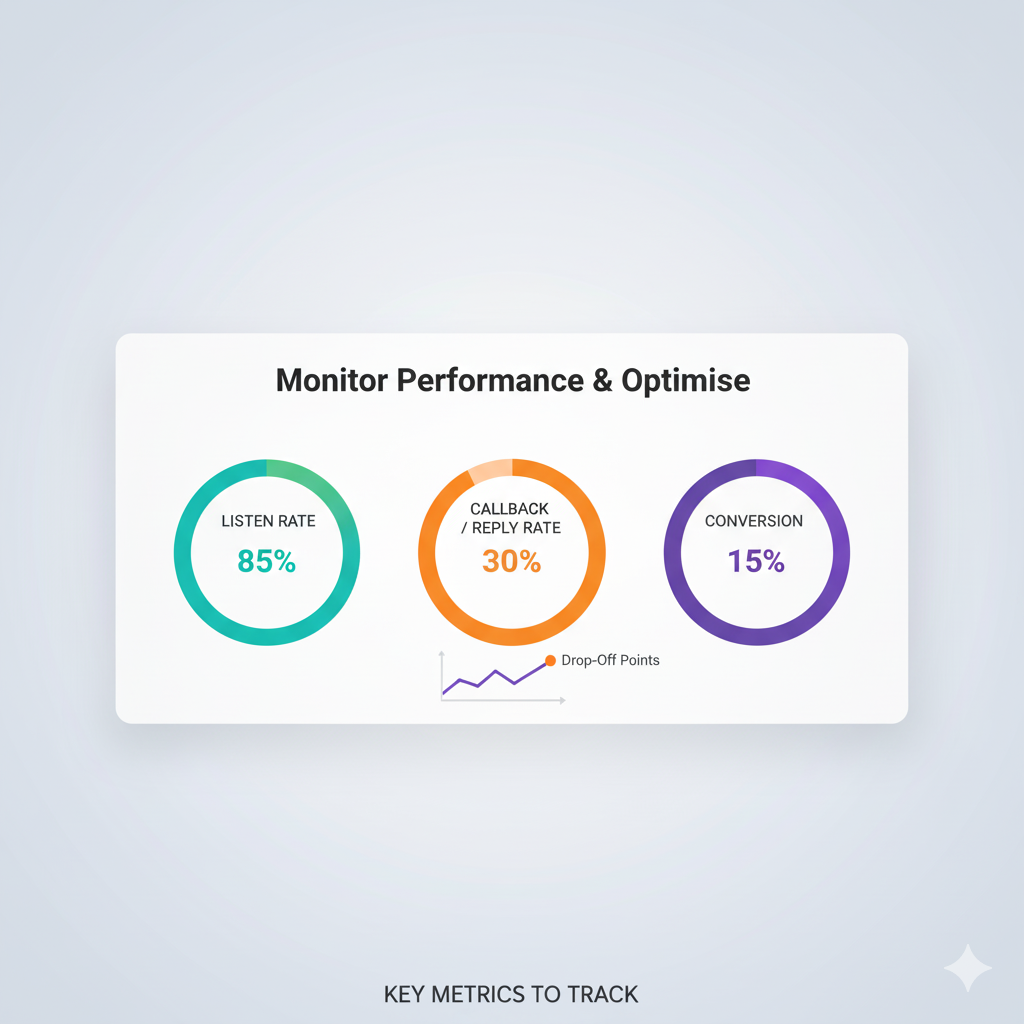
Tracking your results is essential to understand the effectiveness of your reactivation campaigns. Metrics such as listen rates, callback rates, and conversion rates can reveal what’s working and what needs adjustment.
Key Metrics to Track
- Listen Rate: How many recipients actually listen to your voicemail.
- Callback / Reply Rate: Number of leads taking action after hearing the voicemail.
- Conversion Rate: Percentage of re-engaged leads who complete the desired action.
- Drop-Off Points: Identify where prospects disengage to refine your messaging.
Implement A/B testing to test different scripts, CTAs, and timing. Even small adjustments can significantly improve your overall campaign performance.
Step 6: Offer Incentives to Drive Engagement
Dormant leads may need extra motivation to re-engage. Strategic incentives can nudge them back into action.
Effective Incentives
- Limited-time discounts or promo codes
- Exclusive early access to new products
- Free trials or consultations
- Reward points or loyalty bonuses
The key is to make the offer irresistible and relevant to the audience segment. Personalising incentives increases their perceived value and drives higher response rates.
Step 7: Scale Your Reactivation Campaigns
Once you have a successful RVM reactivation campaign, scaling becomes the next priority.
Scaling Strategies
- Expand to additional segments of dormant leads
- Increase automation and multi-step follow-ups
- Introduce new offers or seasonal promotions
- Replicate winning campaigns across regions or products
Scaling effectively allows you to re-engage larger audiences while maintaining personalised, high-converting messaging.
Step 8: Compliance and Best Practices
Reactivation campaigns must adhere to legal and ethical standards. Ringless voicemail is regulated in many regions, so staying compliant is essential.
Compliance Tips
- Only message recipients who have previously provided consent.
- Include opt-out instructions in your follow-up messages.
- Avoid overly aggressive or misleading messaging.
By following best practices, your campaigns maintain credibility, preserve trust, and reduce the risk of penalties.
Leveraging Your Funnel Insights to Reactivate at Scale
Once you’ve implemented your reactivation campaign, the next step is to analyse funnel performance and apply those insights to scale the strategy. Dive into your segmentation data, listen and callback rates, and conversion drop‑off points. Use what you learn to optimise your setup in your main ringless voicemail funnel so that the reactivation funnel becomes part of a broader, repeatable system. For example, you might discover that leads who purchased six‑to‑nine months ago respond better if they receive a two‑step voicemail + SMS follow‑up within 48 hours. By applying these patterns consistently, you move from individual campaigns to a high‑performing framework.
Key actions for scaling:
- Map out the funnel stages where leads drop off most often, then adjust the touch‑points accordingly.
- Build custom segments based on engagement history and attach different voicemail scripts or offers.
- Feed your winning scripts into your main funnel structure as standardised templates this aligns with your overall funnel optimisation strategy.
- Automate the scaling process so that once a segment triggers inactive‑lead status, the system launches the reactivation sequence automatically.
By connecting your reactivation efforts with your overarching funnel architecture and incorporating A/B testing you ensure that every message you send is backed by data, making your funnel more predictable and scalable.
Futureproofing Your Reactivation Strategy with Testing & Innovation
Reactivating dormant leads is not a one‑time process, it’s an ongoing strategy that benefits from continuous testing and adaptation. Incorporate the discipline of structured experimentation from your main funnel into your reactivation campaigns. Regularly using A/B testing frameworks allows you to refine every component of your messages for maximum effectiveness.
Areas for experimentation include:
- Alternative voicemail lengths and tones specifically for inactive leads (who may require a different voice than new leads).
- Timing of delivery: morning vs. evening vs. weekend drops targeted at past customers.
- Incentive types: test offers like “We’ve missed you” vs. “Welcome back discount”.
- Follow‑up cadence: test one voicemail only vs. a sequence of voicemail + SMS + email.
Set up regular review intervals (e.g., monthly) to assess what works, and feed your insights back into your funnel design. Over time, you’ll discover patterns unique to your business e.g., customers who bought 12 months ago respond best to a “we miss you” message with no discount, while those inactive for 24 months require a stronger incentive.
By combining smart experimentation with insights from your ringless voicemail funnel, your reactivation campaigns become smarter, more efficient, and better integrated with your full lifecycle marketing.
Turn Dormant Leads into Loyal Customers
A structured ringless voicemail customer reactivation campaign transforms dormant leads into active prospects with minimal effort. By identifying inactive contacts, crafting personalised messages, automating delivery, integrating follow-up channels, offering incentives, and continuously optimising campaigns, businesses can maximise engagement and revenue from their existing audience.
If you’re ready to contact RinglessVoicemail.ai or explore our platform at RinglessVoicemail.ai, you can start winning back dormant leads and past customers today.
FAQs
1. What is a ringless voicemail reactivation campaign?
It is a marketing strategy that uses ringless voicemail to reach dormant leads or past customers, encouraging them to re-engage with your business.
2. Why should I use RVM instead of email or phone calls for reactivation?
RVM is less intrusive, avoids spam filters, and typically has higher open and response rates compared to cold emails or phone calls.
3. How do I personalise voicemails for reactivation?
Use recipient names, past purchase history, or engagement data to tailor your message. Platforms like RinglessVoicemail.ai automate personalisation at scale.
4. What metrics should I track in a reactivation campaign?
Track listen rates, callback/reply rates, conversion rates, and drop-off points to continuously optimise your campaign.
5. Can I integrate RVM with other marketing channels?
Yes, combining RVM with email, SMS, and social media retargeting can significantly increase engagement and conversions.